Was Daumier a realist
 Daniel Davis
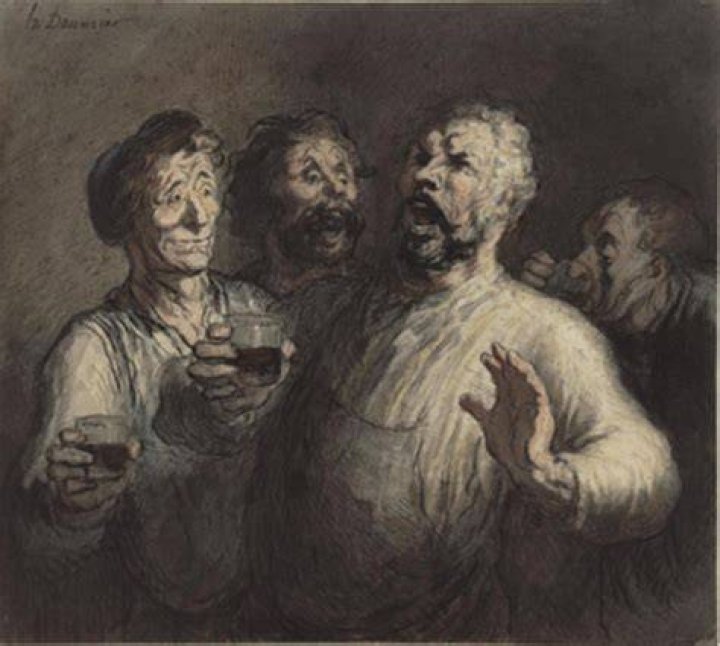
 Daumier pioneered a style of Realism that focused on people of all echelons of society and spared few, with the exception of the working class and the poor, from his sharp wit and scrutinizing eye.
How was Impressionism different that realism?
The main differences between impressionism and realism is that impressionism aimed to capture the essence of the object and it’s relationship with light whereas realism was an attempt to represent subject matter accurately and truthfully particularly ordinary everyday life.
How did Daumier impact French society?
Honoré Daumier was best known for his caricature works and he used the classic caricature techniques of physical absurdity to lay bare the cruelty, unfairness and pretension of 19th century French society and politics.
Was Daumier an impressionist?
Daumier’s working life was divided into two parts: from 1830 to 1847 he was a lithographer, cartoonist, and sculptor; and, beginning in 1848 and lasting until 1871, he was an Impressionist painter whose art was reflected in the lithographs he continued to produce.
Who Painted The Gross Clinic painting and was considered a realist painter?
Thomas Eakins‘ “The Gross Clinic” was completed in 1875 and is regarded as one of the most significant American paintings ever made. The master work of scientific realism features renowned American academic trauma surgeon, Dr.
How was impressionism a reaction to realism?
The turning point from realism to impressionism was the use of light. Artists were finding that painting outside, quickly and in the moment, gave them a chance to understand light and the way it affects color. Brushstrokes became more rapid and broken, representing how light offers a fleeting quality to what we see.
What are Daumier prints?
Honoré Daumier (1808-1879) was a prominent French artist of the nineteenth century. … The prints by Daumier in this collection extend from 1832 to the early 1870s. Daumier was a political progressive of his day, whose satirical art often addressed political and social issues.
What are characteristics of impressionism?
Impressionism is a 19th-century art movement characterized by relatively small, thin, yet visible brush strokes, open composition, emphasis on accurate depiction of light in its changing qualities (often accentuating the effects of the passage of time), ordinary subject matter, unusual visual angles, and inclusion of …
What time was impressionism realism?
Realism to Impressionism (c. 1830-1900)
Why was Daumier imprisoned?
Unlike his editor and publisher, Daumier was charged, fined, and imprisoned for satiric images against the government only once, early on, from late 1832 to February 1833, for his censored Gargantua.
Article first time published on
What did Honore Daumier do?
Honoré Daumier, in full Honoré-Victorin Daumier, (born February 20/26, 1808, Marseille, France—died February 11, 1879, Valmondois), prolific French caricaturist, painter, and sculptor especially renowned for his cartoons and drawings satirizing 19th-century French politics and society.
Was Honore Daumier married?
Daumier had begun living there in 1840 with Marie-Alexandrine Dassy, who was a dressmaker. The couple had a son in 1846 and shortly after the child was born they got married. Two years later the little boy died, although there are no details concerning the circumstances surrounding his death.
Why did the French reject realism?
Realism arose in opposition to Romanticism, which had dominated French literature and art since the late 18th century. Realist painters often depicted common laborers, and ordinary people in ordinary surroundings engaged in real activities as subjects for their works.
Who is founder of realism?
Realism as an art movement was led by Gustave Courbet in France. It spread across Europe and was influential for the rest of the century and beyond, but as it became adopted into the mainstream of painting it becomes less common and useful as a term to define artistic style.
Who started realism in art?
Gustave Courbet was the first artist to self-consciously proclaim and practice the realist aesthetic. After his huge canvas The Studio (1854–55) was rejected by the Exposition Universelle of 1855, the artist displayed it and other works under the label “Realism, G. Courbet” in a specially constructed pavilion.
How does The Gross Clinic represent realism?
Admired for its uncompromising realism, The Gross Clinic has an important place documenting the history of medicine—both because it honors the emergence of surgery as a healing profession (in previous years surgery was associated primarily with amputation, which caused severe medical complications, sometimes killing …
Why did realism meet such criticism in America?
Why did Realist artists depict such poverty in their work? They wanted the viewer to see what real life was like for so many, rather than just the life of the wealthy. … Why was Realism met with such criticism in America? Because of the subject matter.
Why did Thomas Eakins paint The Gross Clinic?
The Gross Clinic is recognized as one of the greatest American paintings ever made. The young and little-known Eakins created it specifically for Philadelphia’s 1876 Centennial Exhibition, intending to showcase his talents as an artist and to honor the scientific achievements of his native Philadelphia.
How many prints did Daumier create?
Daumier was a tireless and prolific artist and produced more than 100 sculptures, 500 paintings, 1000 drawings, 1000 wood engravings, and 4000 lithographs.
How do caricatures differ from cartoons?
Caricature: A likeness that captures a person’s physical traits and simultaneously exaggerates them for humorous (and sometimes mean-spirited) effect. Cartoon: A visual art form consisting of hand or computer-drawn images, often (but not always) created for humorous effect.
What is the difference of Impressionism and Post Impressionism?
1. Impressionism was a style of painting which emphasized color and depicted realistic scenes of ordinary subjects while postimpressionism was a style of painting which was derived from impressionism. 2. Impressionist paintings were done outdoors while postimpressionist paintings were done in a studio.
Who were against Impressionism?
Post-Impressionism is a term used to describe the reaction in the 1880s against Impressionism. It was led by Paul Cézanne, Paul Gauguin, Vincent van Gogh and Georges Seurat. The Post-Impressionists rejected Impressionism’s concern with the spontaneous and naturalistic rendering of light and color.
Why do people not like Impressionism?
The critics and the public agreed the Impressionists couldn’t draw and their colors were considered vulgar. Their compositions were strange. Their short, slapdash brushstrokes made their paintings practically illegible. … This tradition, drawn from ancient Greek and Roman art, featured idealized images.
What is the main idea of expressionism?
Expressionism, artistic style in which the artist seeks to depict not objective reality but rather the subjective emotions and responses that objects and events arouse within a person.
What media is Daumier best known for?
Summary of Honoré Daumier Daumier’s caricatures stand out as his most successful works, yet he remains unrecognized for the impressive diversity of his art as he produced not only the lithographs for which he is famous but also drawings, oil and watercolor paintings, and sculpture.
What recently invented medium did Honore Daumier use in this work?
Daumier used the recent invention of lithography to reach a wide audience for his social criticism and political protest. This print records the horrific 1834 massacre in a workers’ housing block.
What does the third-class carriage represent?
Introduction. The Third-Class Carriage demonstrates Daumier’s renowned sympathy for the poor. Although a bitter caricaturist of the bourgeoisie and politicians, Daumier drops the satire and draws a sensitive picture of the poor.
Why were critics outraged by Courbet's A Burial at Ornans?
It is currently displayed at the Musée d’Orsay in Paris, France. The Salon found Courbet triumphant with The Stone Breakers, the Peasants of Flagey, and A Burial At Ornans. People who had attended the funeral were used as models for the painting. … The critics accused Courbet of a deliberate pursuit of ugliness.
What are lithographs made of?
The printing is from a stone (lithographic limestone) or a metal plate with a smooth surface. It was invented in 1796 by the German author and actor Alois Senefelder and was initially used mostly for musical scores and maps. Lithography can be used to print text or images onto paper or other suitable material.
What is a color lithograph?
An original lithograph is when the artist creates the work of art on a stone plate. … In a color lithograph, a different stone is used for each color. The stone must be re-inked every time the image is pressed to the paper. Most modern lithographs are signed and numbered to establish an edition.
What does being a realist mean?
English Language Learners Definition of realist : a person who understands what is real and possible in a particular situation : a person who accepts and deals with things as they really are. : an artist or writer who shows or describes people and things as they are in real life.